
The Science
How one small bite earns its place in your pet's day — the full story, mechanism by mechanism, ingredient by ingredient.
The 24-hour problem
Every conversation about pet dental care should start with one inconvenient biological fact: plaque never stops. Within hours of any cleaning — a brushing, a chew, a professional scale — a soft, nearly invisible film of bacteria begins re-forming on the tooth surface. Within about a day, it's fully re-established. Left undisturbed, that film does two things: its bacteria digest food particles and release the sulfur compounds you know as dog breath, and the film itself begins to mineralize into tartar — the hard, yellow-brown crust that creeps toward the gum line and won't wipe away.
This is why veterinary dentistry's most-cited figure is so stark: roughly 8 in 10 dogs show signs of gum disease by age three. Not because owners don't care — because the process is silent, painless in its early stages, and relentless on a 24-hour cycle. Any oral-care approach that isn't daily is, by the biology of it, losing ground on the days in between.
Why most fixes fail
The pet aisle offers three broad answers, and each fails in its own way. Minty treats and sprays layer a stronger scent over the sulfur compounds — cologne over the problem, gone in an hour, with the film untouched. Toothbrushing genuinely works and remains the gold standard on paper; in practice, it depends on a patient dog and a persistent human, and most brushing routines quietly die in the second week. Ordinary dental sticks often amount to a treat with a shape — swallowed in seconds, padded with grains and fillers, with ingredient lists that read like a chemistry exam.
The honest conclusion we kept arriving at: the winning solution isn't the most powerful one. It's the one that does real mechanical and botanical work and is so easy — and so wanted by the pet — that it actually happens every single day.
The mechanism, part one: the bite does the brushing
CHOMPERS is built around a deliberately engineered ridged texture. As your pet chews, the ridges do what a brush does: they physically disrupt and polish away the soft plaque film before it can harden into tartar. The geometry matters — the ridges are shaped to reach where buildup begins, along the gum line and on the broad surfaces of the back teeth, the areas owners rarely see and brushes rarely reach on a squirming dog.
Chewing itself brings a second, quieter benefit: it stimulates saliva flow, the mouth's own built-in rinse. Saliva helps wash away food particles and buffers the mouth's environment — one more small daily action on the right side of the 24-hour cycle. This is the core logic of the product: don't fight the daily biology, harness a behavior your pet already loves — chewing — and make every chew do work.
The mechanism, part two: three botanicals with a job
Kelp
The backbone of the recipe. Kelp is a mineral-dense sea green with a long history of traditional use in pet oral care, prized for its naturally occurring iodine, calcium, magnesium and trace minerals. In the bite, kelp is there to support healthy gums and a healthy mouth environment as part of the daily routine — nutrition working alongside the mechanical scrubbing, chew after chew.
Parsley
The oldest breath remedy in the book, and it earned the reputation. Unlike mint-scented masking, parsley — rich in chlorophyll — is traditionally used to address odor at its source rather than perfume over it. It's the reason the CHOMPERS approach to breath is subtraction, not addition: less of what causes the smell, rather than more smell on top.
Pumpkin
The quiet workhorse. A daily product lives or dies on digestibility — something given every single day has to sit gently, for a sensitive-stomached senior dog and a picky cat alike. Pumpkin brings soluble fiber that's famously gentle on pet digestion, keeping the daily habit comfortable so the routine never has a reason to stop.
What we left out — on purpose
Read the back of the bag and you'll notice what isn't there. No grains — the recipe is grain-free, keeping it gentle and appropriate for both dogs and cats. No artificial flavors, colors or fillers — if an ingredient's only job is to make the bite cheaper to produce or prettier to humans, it didn't make the cut. No proprietary blends — the industry's favorite phrase for "we'd rather not say." Every ingredient is on the label in plain language, because a daily product should be one you can explain to your vet in a single breath.
Engineered for the habit
All the mechanism in the world means nothing if the routine dies in week two — so the format is as engineered as the formula. The dose is one bite, because a routine with no measuring, no prep and no cleanup is a routine that survives busy mornings. It takes about ten seconds, most of which is your pet's enthusiasm. It registers as a treat, which means your pet does the reminding after the first week. And each bag holds thirty bites — a clean one-month rhythm per pet that makes reordering thoughtless: new month, new bag.
What to expect, week by week
Week one: the quick wins. The soft film is the first thing daily chewing disrupts, so the earliest changes most parents look for are in breath and how the teeth feel and shine at the surface.
Weeks two and three: the compounding phase. With the film disrupted every day, less new buildup gets the chance to harden. This is the stretch where the routine quietly settles in — and where consistency matters most.
Weeks four to six: the visible check. This is when to do a proper look: lift the lip in good light and examine the gum line and the big back teeth, comparing against where you started. Changes here are slower by nature — which is exactly why we give you sixty days rather than asking you to judge in ten.
The monthly 30-second check, forever: healthy gums are salmon-pink and sit tight against the tooth. A thin red rim at the gum line, dull film that wipes, or hard brown crust that doesn't — those are your three signals, and checking monthly makes you the first to know, in either direction.
The honest limits
We'd rather tell you this here than have you learn it from a vet visit: no chew removes established, hardened tartar. Once mineralized crust has formed, a professional cleaning is the only real fix — daily care is how you protect the result and slow the rebuild afterward. And some signs skip the aisle entirely: bleeding gums, loose teeth, dropped food, pawing at the mouth, or a sudden severe change in breath mean a veterinary visit first. CHOMPERS is a daily treat-style dental bite, not a medical treatment — it helps support fresher breath, cleaner teeth and healthy gums as a routine, and it knows its lane.
The 60-day standard
Everything above is mechanism and reasoning — and reasoning is easy to write. So the proof mechanism is yours: run the routine daily, do the week-six check with your own eyes, and if you're not seeing or smelling the difference, email us within sixty days for every penny back. No forms, no friction. The science gets sixty days to speak for itself — in your house, on your couch, at nose range.
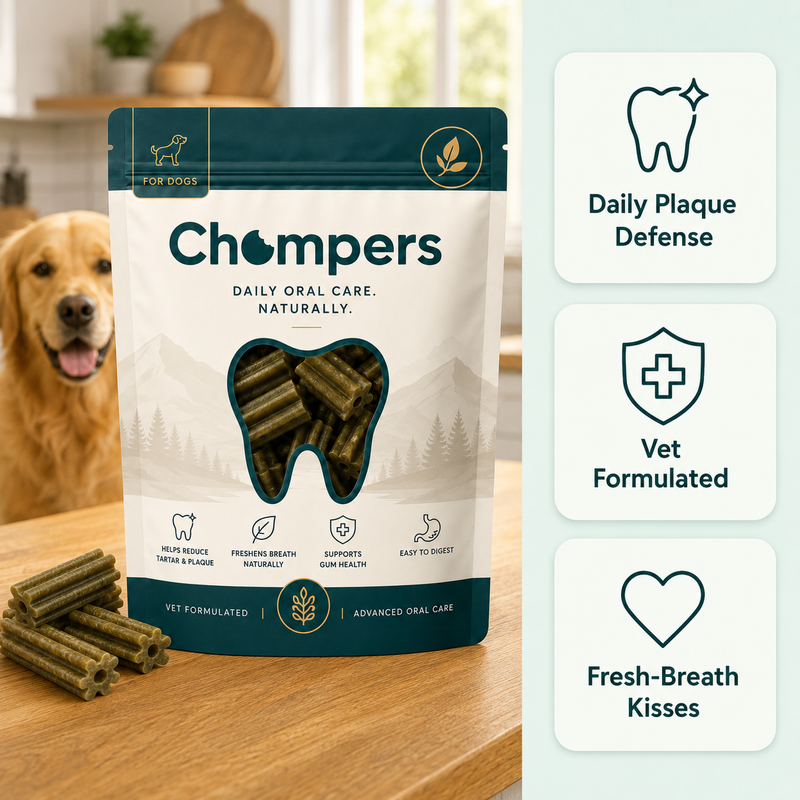
PUT THE SCIENCE TO WORK
CHOMPERS Daily Dental Bites — For Dogs & Cats
$29.00$43.95
- Helps reduce plaque & tartar buildup
- Freshens breath at the source
- Grain-free — kelp, parsley, pumpkin
- 30 bites · one month · one bite a day
60-day money back guarantee on every order